
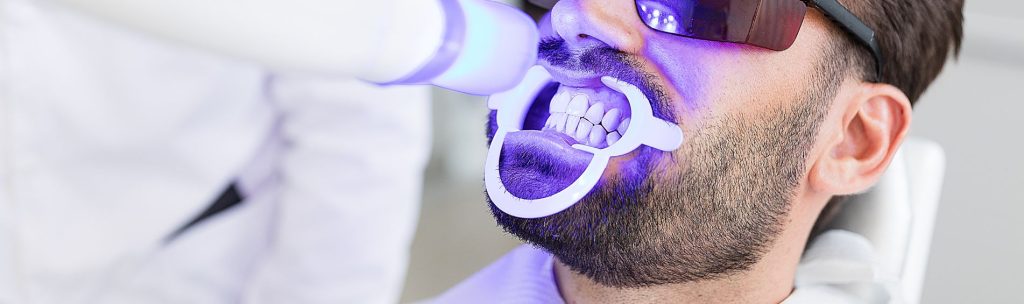
In-clinic LED teeth whitening and at-home kits share the same goal: to lighten the shade of the teeth using whitening agents. However, they do not work in exactly the same way or offer the same level of control.
There is also one difference that often goes unnoticed: the key does not lie solely in the presence of an LED light, but also in the product used, the treatment protocol and the initial assessment of the mouth.
How Does Teeth Whitening Work?
To understand the differences, it is helpful to first know what actually causes the change in colour. Whitening treatments commonly use substances such as hydrogen peroxide or carbamide peroxide. These agents act on the molecules responsible for certain types of discolouration and alter the colour of the tooth.
Therefore, the LED light is not what “paints” the tooth white. The whitening agent is a fundamental part of the process, while the light may form part of the protocol used to support or accelerate the reaction, depending on the system employed. Scientific evidence on the additional benefits of different light-activation systems is not consistent, so a treatment should not be assessed solely on the presence of an LED lamp.
It is also important to distinguish between surface stains, which may be linked to certain foods, drinks or tobacco use, and discolouration found deeper within the tooth. Not all types of discolouration respond to whitening in the same way.
What Makes In-Clinic LED Teeth Whitening Different?
With professional LED teeth whitening, the treatment is carried out in a dental clinic as part of a controlled protocol. Before starting, the dental professional can assess the condition of the teeth and gums, the type of discolouration, the presence of restorations and any history of sensitivity.
During the session, the gums are protected to reduce contact with the whitening gel, and its application is carefully controlled. Depending on the protocol chosen, the product may be combined with a light source.
The main advantage of this system is the level of control throughout the procedure. The amount of product used, the exposure time and the protection of the soft tissues do not depend on the patient deciding how much gel to apply or how long to leave it on.
Another common difference is speed. Treatments carried out in the dental practice are designed to achieve a change in tooth colour over a more concentrated period, whereas at-home options usually require repeated applications over several days or weeks.
How Do At-Home Teeth Whitening Kits Work?
An important distinction needs to be made here. Not all at-home treatments are the same.
On the one hand, there are over-the-counter kits that may include universal trays, strips, gels, brushes or small LED lights. They are used without a personalised assessment, and their features can vary considerably from one product to another.
On the other hand, there is dentist-supervised at-home teeth whitening. In this case, the patient carries out part of the treatment at home but follows a protocol recommended by a dental professional and may use trays fitted to their teeth. This should not be confused with buying a generic kit and starting to use it without knowing whether it is suitable for the mouth.
This difference matters because a well-fitting tray helps to distribute the product in a more controlled way. A poor fit or an excessive amount of gel can increase contact with the gums and lead to greater irritation. Tooth sensitivity and temporary gum inflammation are among the most common adverse effects of teeth whitening.
LED Teeth Whitening vs At-Home Kits: Key Differences
The first difference is personalisation. In a dental clinic, treatment can be planned after assessing the condition of the mouth. A generic kit is marketed for many different people and does not take into account the specific cause of each person’s tooth discolouration.
The speed of the process also differs. In-clinic treatment concentrates the procedure into one or more appointments, depending on the individual case, whereas at-home systems usually require more consistency and time.
The third factor is gum protection. In the dental practice, specific measures are used to limit contact between the gel and the soft tissues. At home, the outcome depends more heavily on how well the system fits and whether the instructions are followed correctly.
Finally, there is the ability to monitor progress. When a treatment is supervised, it is possible to assess whether excessive sensitivity develops, whether the change in shade is even or whether the treatment plan needs to be adjusted.
This does not mean that every in-clinic treatment is automatically better than every at-home option. A dentist-recommended and supervised at-home system is very different from a product purchased without a prior dental assessment.
Does LED Light Make Teeth Whiter?
This is one of the most common questions. The presence of an LED light can make a product appear more advanced, but it should not be the only factor considered when choosing a treatment.
What really matters is the treatment as a whole: the whitening agent, how it is applied, the contact time, the diagnosis of the type of discolouration and the measures used to protect the mouth.
For this reason, two kits with seemingly similar lights can offer very different experiences. Even an at-home LED device does not automatically make a product equivalent to a treatment carried out in a dental clinic.
Which Option Causes Less Tooth Sensitivity?
There is no single answer that applies to everyone. Tooth sensitivity can occur with both treatments carried out in the dental practice and at-home systems.
Factors such as the concentration of the whitening agent, contact time, frequency of application and the patient’s existing sensitivity can all play a role. In many cases, the discomfort is temporary, but an overly intensive treatment or incorrect use can make it more uncomfortable.
This is where the importance of a prior assessment becomes clear again. A person with cavities, gum problems, exposed dentine or existing sensitivity should not choose a system based solely on a before-and-after photograph.
Do All Teeth Respond to Whitening in the Same Way?
No. The outcome depends partly on the cause of the discolouration and the individual characteristics of each person’s mouth.
In addition, whitening works on natural teeth, but it does not change the colour of crowns, veneers, implants or other tooth-coloured restorations in the same way. This can result in visible differences in shade if it is not taken into account before treatment begins.
For this reason, before thinking about how many shades can be achieved, it is important to know which teeth need to be lightened, what previous treatments are present and whether an even result can be achieved.
So, In-Clinic LED Teeth Whitening or an At-Home Kit?
For those looking for a more concentrated procedure, professional control during application and a personalised assessment, in-clinic teeth whitening offers clear advantages.
At-home treatments can be useful when a more gradual process is preferred. However, in our experience, it is essential to distinguish between a system recommended by a dentist and a generic kit used without first assessing the condition of the teeth and gums.
At Quality Dent, our dental clinic in Sabinillas, we offer teeth whitening as part of our cosmetic dentistry treatments. Before recommending any option, we assess the condition of the mouth to determine which approach may be most suitable in each case. In addition, if you would like to find out more before making a decision, you can read our article on the myths and facts about teeth whitening.
Our recommendation is simple: do not choose a whitening treatment solely because it includes an LED light, and do not assume that all at-home kits are the same. For us, the real difference lies in how the treatment is planned, which product is used, how the mouth is protected and whether a proper assessment is carried out beforehand.